
By the end of a long shift your legs feel like they belong to someone else. Heavy, tired, aching from the knee down, maybe a little puffy around the ankles. You sit, put your feet up, and twenty minutes later they feel almost normal again.
Aching legs after standing all day is one of the most common reasons people end up in a vein specialist’s office, and one of the most commonly brushed off. It gets blamed on age, on the job, on concrete floors. Sometimes that really is all it is. Often it is your veins telling you they are not keeping up.
Why standing still is harder on your veins than walking
Here is the part that surprises most people: walking is easier on your leg veins than standing still is.
Every time you take a step, the muscles in your calf squeeze. That squeeze works like a pump, pushing blood up out of your legs and back toward your heart against gravity. It is the main reason blood does not simply collect in your feet over the course of a day.
Stand in one place for hours and that pump barely runs. Blood sits in the veins of your lower leg, pressure builds inside them, and fluid gradually seeps out into the surrounding tissue. That pressure and that fluid are what you feel as aching and heaviness.
It also explains the part people find reassuring. The ache fades quickly once you sit down and raise your legs, because you have taken gravity out of the equation and given the blood an easier route back.
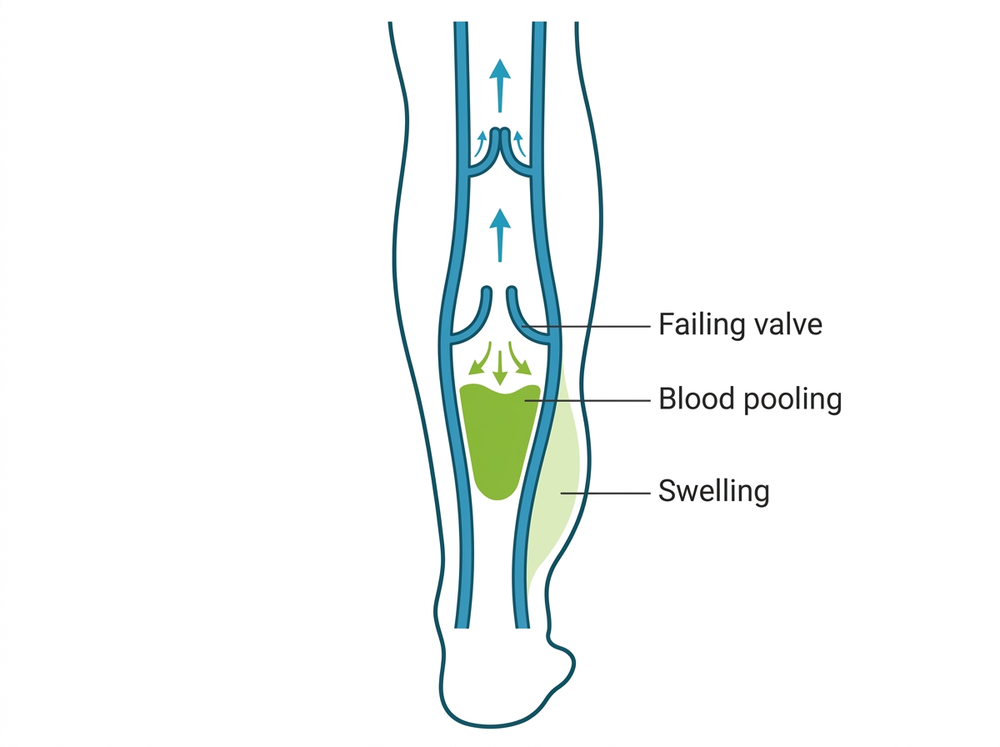
Five common causes of aching legs after standing all day
Not every case has the same cause, and the difference matters, because the treatments are not the same either.
1. Vein valves that no longer close properly. Your leg veins contain small one-way valves that keep blood moving upward. When they weaken, blood leaks back down and pools. This is called chronic venous insufficiency, and it is the single most common reason for aching legs after standing all day.
2. Varicose veins. When pooling stretches a vein far enough, it becomes visibly enlarged and twisted. Varicose veins can ache on their own, and they are a visible sign that the valve problem above is already well established.
3. Ordinary muscle fatigue. Standing still is static work. Your postural muscles hold tension for hours without the rhythmic contraction they get from walking, and they get sore. This kind of ache usually clears overnight and does not come with swelling or visible veins.
4. Your feet and arches. Flattened arches or unsupportive shoes change how load travels up the leg, which can produce aching in the calves and shins that has nothing to do with your veins at all.
5. Knee or hip arthritis. Worn joints ache more the longer they are loaded. This one tends to be felt in the joint itself rather than spread through the calf, which is usually the clue that separates it from a vein problem.
When aching legs need prompt attention
Aching legs after standing all day is not usually an emergency. A few things are.
Sudden swelling in one leg, especially with pain, warmth, or redness in the calf, needs same-day medical attention. That combination can indicate deep vein thrombosis, a clot in a deep leg vein, which is very treatable but dangerous to ignore.
Get checked promptly, though not urgently, for an open sore near the ankle that is not healing, brown or reddish staining of the skin above the ankle, or skin that is becoming hard and tight. Those are signs that vein pressure has been high for a long time and the skin is starting to suffer for it.
How Help My Legs works
Tell us your symptoms
Answer a few quick questions about the aching, any swelling, and how long you are on your feet.
We match you locally
We connect you with a qualified leg and vein specialist near your ZIP code.
You get seen
The office reaches out to schedule your visit. No obligation, no pressure.
What actually helps
The first moves against aching legs after standing all day are practical and cost nothing. Break up long stretches of standing, even briefly. Rocking up onto your toes a few times an hour runs the calf pump on purpose. Elevate your legs above heart level for fifteen minutes when you get home.
Graduated compression stockings are the most effective step you can take without seeing anyone, because they support the vein walls from outside and help the valves close. The National Heart, Lung, and Blood Institute notes that aching and heaviness in the legs often get worse when you are on your feet for long periods, and lists both compression therapy and raising your legs above the level of your heart as ways to bring the pressure down.
Where the valves themselves have failed, these measures manage the symptom rather than fix the cause. That is the point at which vein ablation becomes worth discussing: a minimally invasive office procedure that seals the failing vein so blood reroutes through healthy ones nearby. Not everyone needs it, and a quick ultrasound is what determines whether it applies to you, not the severity of the ache.
When it is not your veins
Two other patterns are worth knowing, because they point somewhere else entirely.
If your legs ache while you walk and settle within a few minutes of stopping, rather than building up over a day on your feet, that pattern points toward the arteries instead. That is the hallmark of peripheral artery disease, and we walk through it in detail in leg pain when walking.
And if the dominant sensation is burning, numbness, or pins and needles rather than a deep ache, peripheral neuropathy is the more likely explanation than anything to do with your veins.
If you are not sure which of these sounds like you, our quick candidate check walks through it in about a minute. You can also read more about heavy legs as a symptom in its own right.
Questions people ask
Why do my legs ache more after standing than after walking?
Walking runs the calf muscle pump, which pushes blood up out of your legs. Standing still leaves that pump idle, so blood pools in the lower leg and pressure builds. That is why a day behind a counter can hurt more than a long walk.
Does aching legs after standing all day always mean vein disease?
No. Muscle fatigue, foot mechanics, and joint arthritis can all produce the same complaint. The pattern that points toward veins is aching with heaviness or swelling that builds through the day and improves when you elevate your legs.
Do compression stockings help aching legs after standing?
For most people with vein-related aching, yes. They support the vein walls and help the valves close, which reduces pooling. They manage the symptom rather than repair the valves, so the ache usually returns if you stop wearing them.
When should I see a specialist about aching legs?
If aching legs after standing all day is affecting your sleep or your work, if you can see varicose veins, or if you are getting swelling, skin staining, or a sore near the ankle, it is worth having the veins looked at. Sudden one-sided swelling with pain or warmth needs same-day care.