
It usually gets noticed by accident. A sock line, a summer, a photograph, and the skin just above the ankle is a shade of brown that was not there a few years ago. It does not hurt. It does not itch, at least not yet. So it gets filed under aging, or under a tan that never quite came off, and nothing happens.
Brown stains around ankles are worth understanding, because of all the things a leg can do, this one is the least dramatic and the most informative. The mark is not on the skin. It is in it, and it got there from the inside. MedlinePlus describes what is happening underneath as blood pooling in the lower leg veins, where fluid and blood cells leak out of the veins into the skin and other tissues.
What follows is what the color is made of, what it says about how long this has been going on, the honest answer to whether it fades, and what a specialist does about it. The other colors a leg can turn are covered separately, because most of them point at the arteries rather than the veins, and this one is firmly a vein story.
What the brown actually is
Veins in the leg move blood upward against gravity, and small valves inside them stop it falling back between heartbeats. MedlinePlus describes venous insufficiency as what happens when vein walls are weakened and valves are damaged, so the blood no longer moves reliably in one direction.
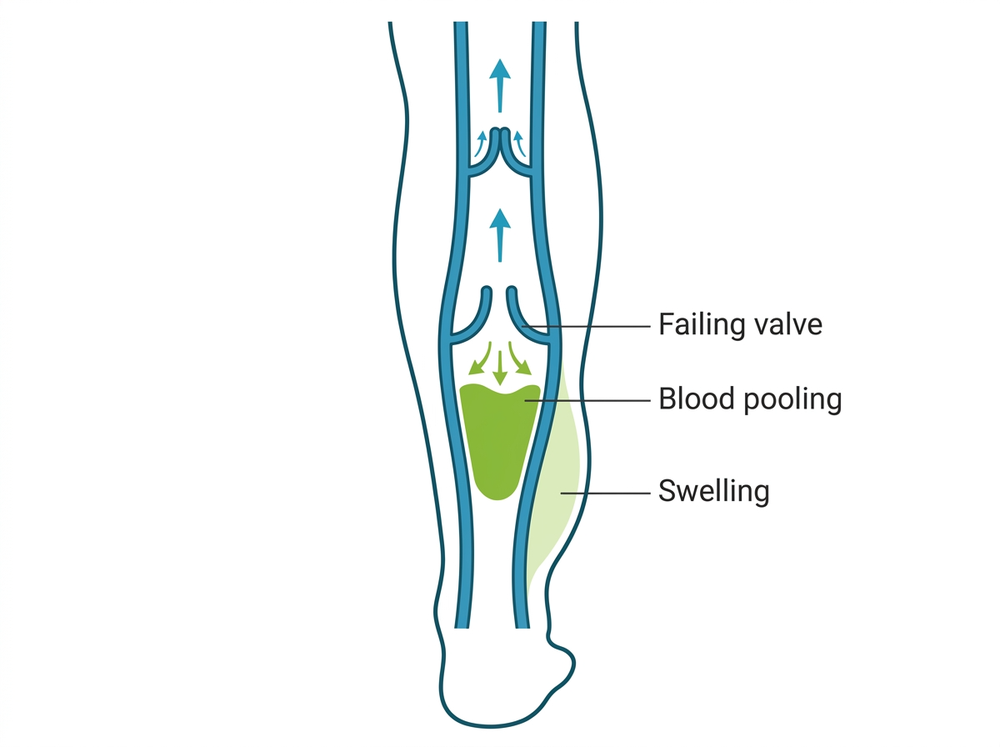
Pressure then builds in the lowest part of the system, which is the few inches above your ankle bone. That is where the smallest vessels sit under the most load for the longest time, and it is why the color appears there rather than on the calf or the thigh.
The staining itself is what gets left behind when that leaked blood breaks down in the skin. The medical name for the whole picture is stasis dermatitis, and the brown is the part of it that does not wash off, because it is a deposit inside the tissue rather than a mark on the surface of it.
Two things it is not. It is not a bruise, which arrives after a knock and clears within a couple of weeks. It is not a tan, which follows the sun rather than a particular band of skin above both ankles. Chronic venous insufficiency is the condition behind it, and the color is one of the few outward signs it ever produces.
Brown stains around ankles: five things the color is telling you
None of this is a diagnosis. It is what the mark usually means, and what it is worth doing with that.
1. It came from inside, not from outside. Nothing you put on the skin caused it and nothing you put on the skin will lift it, because the pigment sits below the surface. That is the single most useful thing to know, and it is why creams bought for it are almost always a disappointment.
2. It is a record of time, not of pain. Staining builds over years of raised pressure. Plenty of people with a clear band of brown have legs that ache only mildly, and plenty with heavy aching have no color at all. The two measure different things, so a comfortable leg is not an argument against what you are looking at.
3. It marks the spot the system is weakest. The color sits above the ankle because that is where the pressure is highest, which is also where a sore that will not heal tends to appear if this carries on. MedlinePlus notes that venous ulcers most often form on the inside of the ankle, which is usually the darkest part of the stain.
4. Some of it is permanent. MedlinePlus states it plainly: over time, some skin changes become permanent, and skin that has turned dark brown is on that list. This is the sentence that changes what the mark is for. It is not a cosmetic problem waiting for the right cream, it is a clock.
5. It is an argument for acting earlier rather than later. The National Heart, Lung, and Blood Institute puts it simply: getting treatment early can stop your varicose veins from getting worse and helps avoid bleeding and ulcers. Nothing about staining is urgent today. Everything about it is easier a year ago than a year from now.
Does the staining ever go away?
This is the question everybody actually wants answered, and it deserves a straight answer rather than an encouraging one.
Early and light discoloration can settle once the pressure behind it is dealt with and the swelling comes down. Established, darker staining usually does not. MedlinePlus is direct that some skin changes become permanent over time, and the deep brown is the usual example. Treatment is aimed at the vein problem underneath and at stopping the skin from going further, not at restoring the color you had.
That sounds discouraging written down and it is not meant to be, because the thing worth protecting is not the shade of your ankle. It is the skin’s ability to stay intact. Skin that is stained still works. Skin that has thickened, hardened and broken down is a different and much slower problem, and that is the step this is sitting in front of.
It is also worth knowing that the veins behind it do not quietly correct themselves either. Whether varicose veins ever go away on their own has the same answer for the same reason: a valve that has stopped closing does not start again.
What usually turns up alongside it
Staining rarely travels alone. Most people, once they think about it, recognize several of these, and the combination is far more useful to a specialist than the color by itself.
Swelling that is worse by evening. The sock mark at the end of the day, the shoe that fits in the morning and not at six o’clock. Legs that swell by night and settle overnight is the classic venous pattern.
Aching or heaviness after standing. Not a sharp pain, more a dull weight that improves when the leg is up. Aching legs after a day on your feet covers why standing makes it worse.
Dry, itchy or flaky skin in the same band. MedlinePlus lists irritated or cracked skin and red, swollen, crusted or weepy skin among the skin changes in the legs that come with venous insufficiency. Scratching it is the thing most likely to turn a stain into a wound.
Skin that is starting to feel firm. MedlinePlus describes thickening and hardening of the skin on the legs and ankles, which has its own name, lipodermatosclerosis. If the lower leg is beginning to feel tight or woody rather than soft, that is a reason to be seen sooner.
Visible veins, or none at all. This surprises people. The staining can appear in a leg with obvious varicose veins and in a leg with nothing visible on the surface, because the vein doing the damage can be deeper than the ones you can see. Telling varicose veins from spider veins explains why appearance is a poor guide to what is happening underneath.
When ankle skin needs seeing quickly
Staining itself is not an emergency and never has been. These are different.
- An open sore or ulcer near the ankle that is not healing, or one that healed and has come back
- Bleeding from a vein in or near the stained area, which can be heavy from a vein under pressure
- Skin that is red, hot and tender, or redness that is spreading, particularly with a fever
- Sudden swelling, warmth or pain in one calf rather than both legs
- Skin that is thickening, tightening or weeping over weeks rather than years
The second one is the one people underestimate. The National Heart, Lung, and Blood Institute treats bleeding from varicose veins as a 911 emergency, because a vein carrying that much pressure does not stop on its own the way a cut usually does. The fourth is not a skin problem at all. It is the description of a possible clot in a deep vein, and it is assessed the same day.
How Help My Legs works
Tell us your symptoms
A short form, in plain language. No account, no cost, and it takes about a minute.
We match you locally
We look for a specialist near you who treats the specific problem you described.
You get seen
You are put in touch directly. What you decide after that is entirely up to you.
What happens at the appointment
Less than people expect, and none of it involves the skin to begin with.
The useful question is not what shade the ankle is, it is which vein is letting blood fall backward. MedlinePlus says a duplex ultrasound exam of your leg may be ordered to check how blood flows in the veins. It is a probe and gel on the skin, nothing breaks the surface, and it is the test that turns a visible mark into a specific answer about a specific vein.
What follows depends on what the scan finds. MedlinePlus lists compression stockings to improve blood flow in the legs, and, for the vein itself, office procedures including laser and radiofrequency ablation, foam, glue and sclerotherapy. Whether compression stockings actually do anything is a fair question with a real answer, and vein ablation is the route most often discussed when the scan shows one faulty vein doing most of the damage.
Two practical notes. Who turns out to be a candidate depends on the scan rather than on how the leg looks, and skin changes above the ankle count for a good deal when an insurer reviews a vein claim, because they are the thing that separates a medical problem from a cosmetic one. If you have been putting off asking because you assumed this was about appearance, that assumption is working against you twice.
Questions people ask about brown stains around ankles
What causes brown stains around ankles?
Pressure in the leg veins. MedlinePlus describes blood pooling in the lower leg veins, with fluid and blood cells leaking out into the skin and surrounding tissue. The color is what is left behind as that blood breaks down inside the skin, which is why it sits in a band above the ankle where the pressure is highest, and why it does not wash off. The underlying condition is usually chronic venous insufficiency, meaning the valves inside the leg veins are no longer closing properly.
Will the brown color ever fade?
Early, light discoloration can settle once the pressure and swelling behind it are treated. Established dark staining usually does not. MedlinePlus states that over time some skin changes become permanent, and skin that has turned dark brown is one of its examples. That is worth knowing early rather than late, because treatment is aimed at the vein problem underneath and at keeping the skin intact, not at restoring the color. The thing being protected is the skin, not the shade.
Is it dangerous, or just a cosmetic thing?
It is not dangerous today and it is not cosmetic either. It is a sign that the pressure in the leg veins has been raised for a long time, and the same area is where venous ulcers most often form, which MedlinePlus places on the inside of the ankle. The National Heart, Lung, and Blood Institute notes that treating the underlying vein problem early can stop things getting worse and help avoid bleeding and ulcers. So the stain is not the problem. It is the notice.
I have the staining but no visible varicose veins. Does that make sense?
Yes, and it is common. The vein responsible can sit deeper than anything visible at the surface, so a leg can look unremarkable and still have significant backward flow. This is one reason the scan matters more than the appearance of the leg. A duplex ultrasound looks at how blood actually moves through the veins rather than at which ones can be seen, and it is routinely the thing that explains a leg nobody could account for by looking at it.
What can I do myself in the meantime?
Keep the leg moving, get it up when you are sitting for long stretches, and treat the skin gently, because scratching a dry, itchy patch in that band is the most common way a stain becomes a wound. Compression is often recommended, but the right type and pressure depend on your circulation, and it should be checked rather than guessed, particularly if the arteries have ever been a question. None of this reverses the color. All of it helps protect the skin while the vein itself is sorted out.
So: brown stains around ankles are venous rather than arterial, they are a deposit inside the skin rather than a mark on it, they measure years rather than severity, and the darker ones tend to be permanent. What is worth saving is not the color but the skin, and the window for that is open now and narrowing slowly.
If the ankle skin has changed and nobody has looked at the veins behind it, a short symptom check takes about ninety seconds, and leg swelling has several causes worth telling apart before you assume which one is yours.