

Lasting Knee Pain Relief, Without Surgery
If chronic knee pain from arthritis is wearing you down, there is a newer option before major surgery. A simple, minimally invasive treatment can calm the inflammation driving your pain, with no incisions and no knee replacement.
What this treatment is
It is a modern, minimally invasive procedure that eases chronic knee pain caused by osteoarthritis, without surgery on the knee itself.
With knee arthritis, the lining of the joint becomes inflamed and grows extra tiny blood vessels that feed the pain. This treatment, known medically as genicular artery embolization (GAE), gently reduces the blood flow to that inflamed lining, which calms the inflammation and quiets the pain signals.
It is done through a tiny pinhole using a thin, flexible tube called a catheter, guided by live imaging. There is no cutting into the knee, no implant, and no general anesthesia, so it is often a good option for people who are not ready for, or want to avoid, a knee replacement.
How the treatment works
A simple, image-guided procedure, usually done in a couple of hours.
- 1
Numb the area
A small spot of local anesthetic numbs the skin. You stay awake and relaxed, with light sedation if needed.
- 2
Guide the catheter
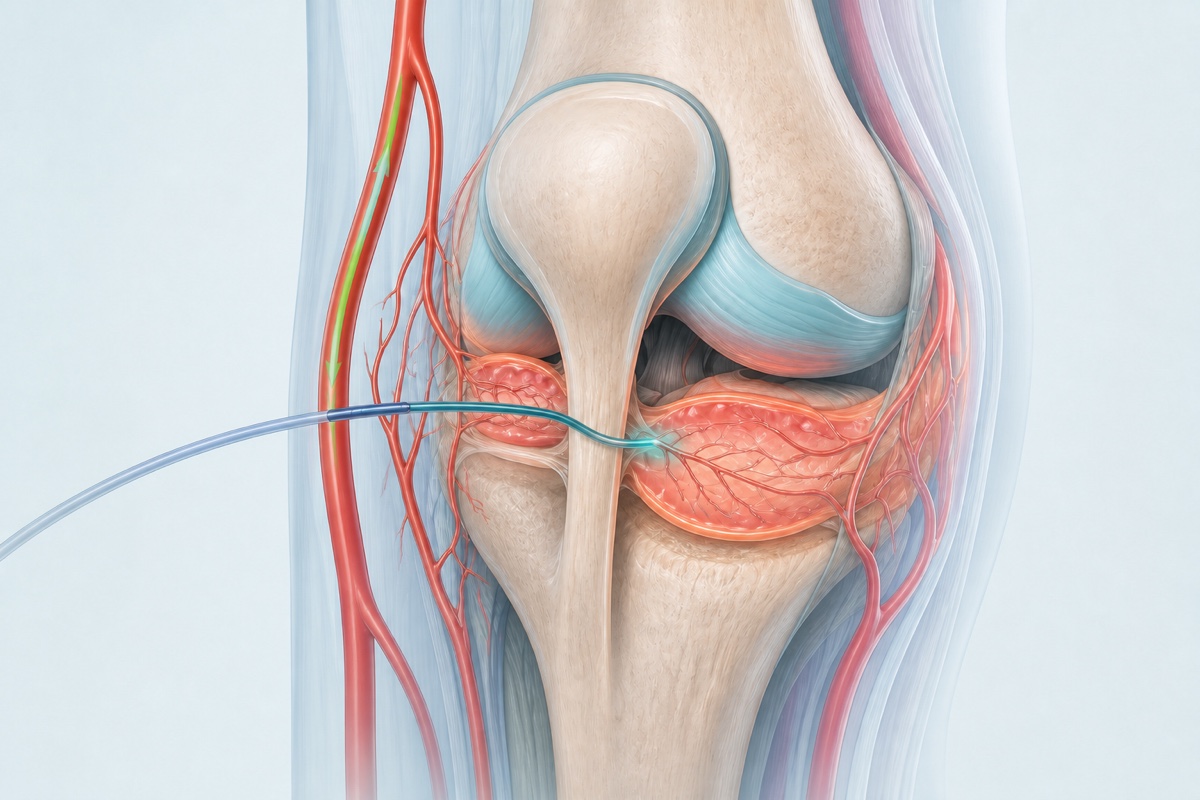
A thin tube is guided to the small arteries feeding the inflamed knee lining.
- 3
Calm the inflammation
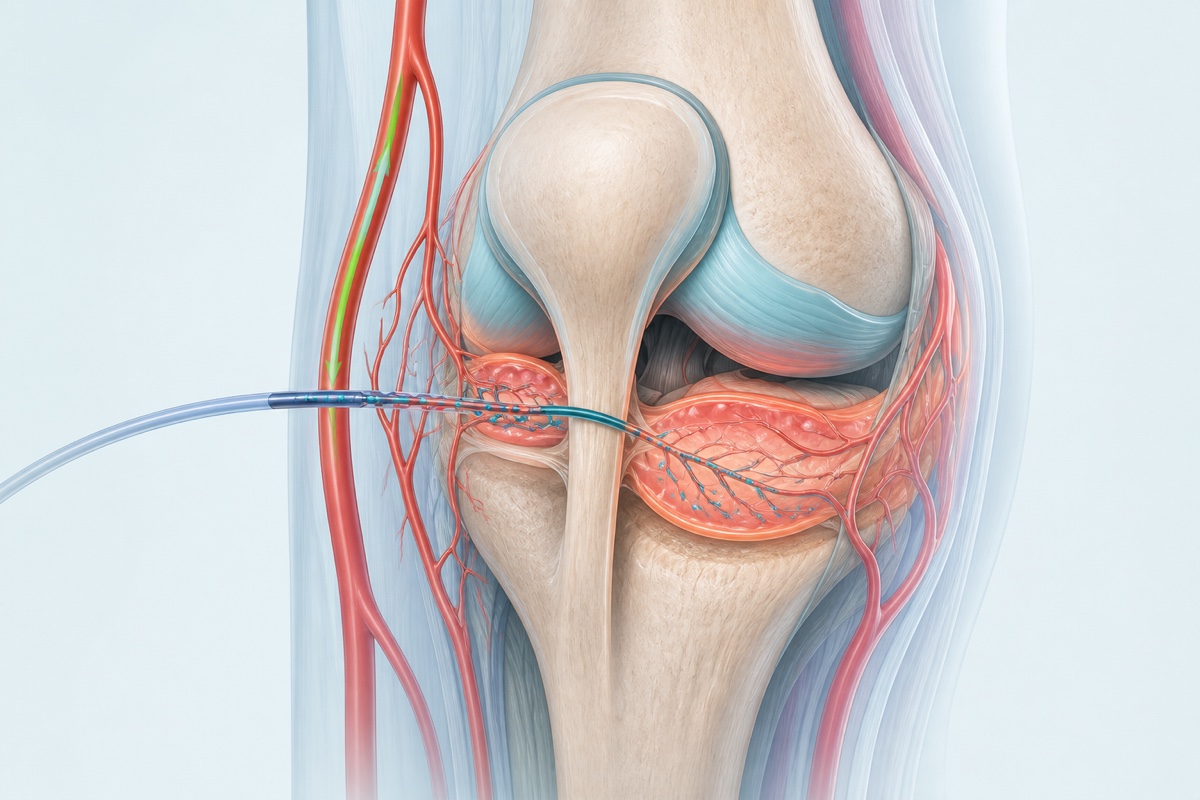
Microscopic particles gently reduce blood flow to the inflamed lining, easing the source of pain.
- 4
Pain settles
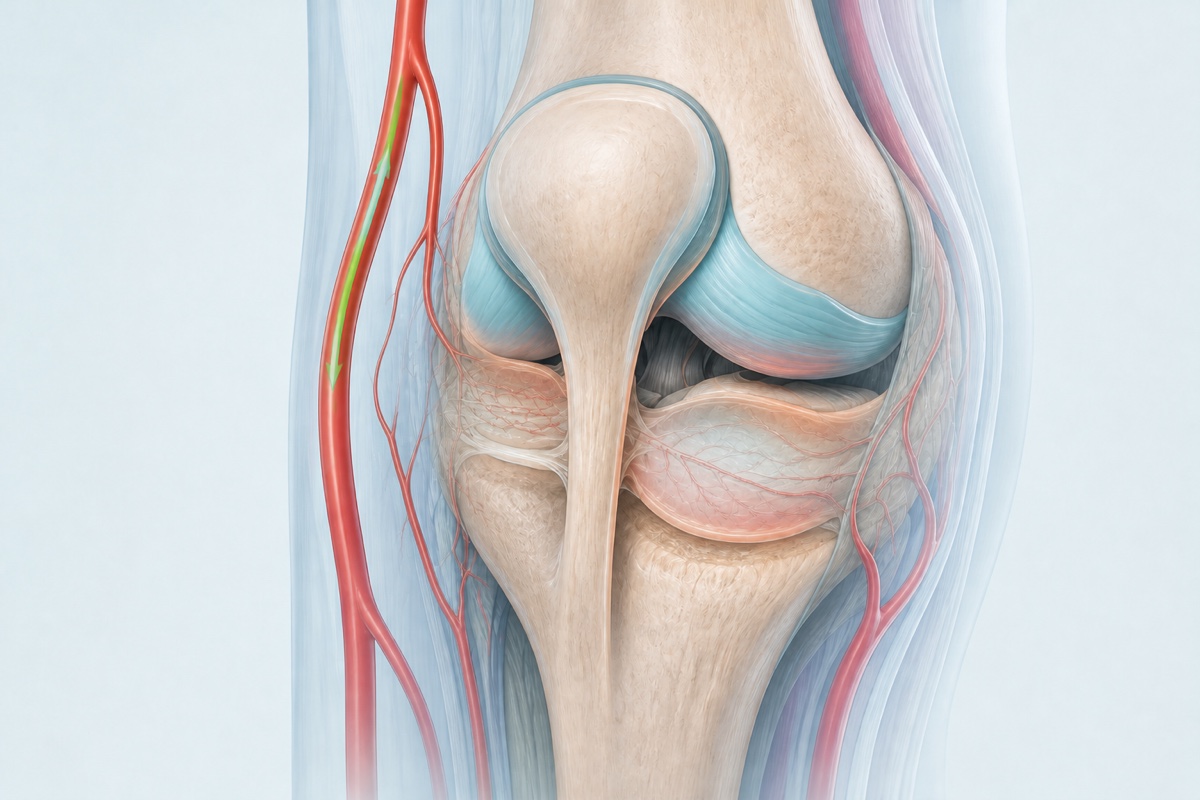
The tube is removed, leaving a small bandage. Many people feel gradual relief over the following weeks.
How GAE targets inflammation around the knee
Move through the four stages to see how a specialist guides a catheter to selected small vessels while keeping the main artery open.

Why patients choose it
A gentler path to knee relief.
No surgery on the knee
No incisions, no implants, and your natural knee stays intact.
Awake, no general anesthesia
Local numbing and light sedation make it comfortable and low-stress.
Quick and outpatient
Usually done in a couple of hours, with no hospital stay.
Fast recovery
Most people are back on their feet quickly, with little downtime.
An option before surgery
A choice for people not ready for, or wanting to delay, a knee replacement.
Real, lasting relief
By calming the inflammation, it targets a true source of the pain.
A gentler alternative to knee surgery
How this minimally invasive treatment compares with knee replacement surgery.
| Minimally invasive treatment | Knee replacement surgery |
|---|---|
| Tiny pinhole, no incision on the knee | Open surgery with a replacement implant |
| Keeps your natural knee, no implant | General or spinal anesthesia |
| Local anesthesia, home the same day | A hospital stay is common |
| Little downtime | Weeks of rehabilitation |
A specialist will help you decide the best path. This treatment is often used for mild to moderate arthritis, or when surgery is not the right fit yet.
Before the procedure: what a specialist checks
Genicular artery embolization is not offered on the strength of a sore knee. Two things have to line up first: the type of pain, and what you have already tried.
The pain that responds best is the inflammatory kind. Knees that are tender to press around the joint line, that ache after activity and often at night, and that feel warm or puffy during a flare. Pain that is mainly mechanical, a knee that locks, catches or gives way, is usually pointing at something inside the joint that this does not address.
An X-ray confirms the degree of arthritis, and it is used to rule out rather than to qualify. Very advanced disease, where the joint surfaces are already in contact across the whole knee, generally does better with a replacement. Mild disease usually does better with strengthening first.
You will also be asked what you have tried, and for how long. Structured exercise, weight reduction where relevant, simple pain relief, and often an injection. That sequence is the benchmark this procedure is measured against. Our page on knee osteoarthritis sets out the full ladder.
What the results actually look like
The realistic aim is a meaningful reduction in pain and better day-to-day function, not a knee that behaves like it did at forty.
Relief is usually gradual rather than immediate. Some people notice a change within days as inflammation settles, but the fuller effect typically builds over several weeks as the excess blood supply feeding the joint lining reduces.
Two things it does not do, and both matter. It does not regrow cartilage, so the arthritis itself is unchanged on any future scan. And it is not guaranteed: a proportion of people get little benefit, and there is no reliable way to identify them in advance.
For those who do respond, published follow-up has reported that improvement can be sustained for a couple of years. That is a genuine result and it is also not a permanent cure, so it is best understood as buying good years, and often as delaying rather than replacing surgery. Our article on genicular artery embolization covers the evidence in more detail.
What protects the result afterwards is the same strengthening work that came before it. The procedure makes that work possible by reducing pain; it does not remove the need for it.
Risks, stated plainly
This is a low-risk, minimally invasive procedure, and it still carries risks you should hear named rather than summarised.
The common effects are minor and temporary. Bruising and soreness where the catheter went in, usually at the top of the thigh or the wrist. Some people get a temporary patch of skin discolouration or a small area of numbness over the knee, which typically fades over weeks.
The procedure uses X-ray guidance and contrast dye. That means a dose of radiation, and dye that is processed by the kidneys, so kidney function is checked beforehand and people with reduced function need extra care rather than exclusion.
The uncommon but specific risk is that the tiny particles used reach a small area they were not intended for, which can cause a patch of skin irritation or, rarely, a more persistent problem. Reducing that risk is the entire reason the specialist maps the vessels carefully before treating and works through very small branches.
As with any arterial procedure there is a small risk of bleeding, infection at the access site, or injury to the artery. These are uncommon, and how often the person doing it performs the procedure is a fair thing to ask about.
When a different approach is the better one
Being told this is not the right procedure for you is a useful answer, not a rejection, and it happens at both ends of the range.
If your arthritis is early and you have not done a structured strengthening programme, that comes first. It has the best evidence of anything on the list, it costs nothing but effort, and it remains worth doing whatever you choose later.
If your knee is severely worn, with bone effectively on bone across the joint and pain at rest, a knee replacement is likely to give a better and more durable result. Choosing a smaller procedure at that stage often means going through two.
If the dominant problem is locking, catching or the knee giving way, that suggests a mechanical issue such as a torn meniscus or loose fragment, which needs a different assessment entirely.
And if the knee is hot, red, and swollen over hours rather than days, that is not arthritis behaving badly. That needs urgent medical assessment the same day.
How Help My Legs works
Tell us your symptoms
Answer a few quick questions about your knee pain and how it affects you.
We match you locally
We connect you with a qualified specialist near your ZIP code.
You get seen
The office reaches out to schedule your visit. No obligation, no pressure.
Common questions
Does it hurt?
Most people feel little more than a small pinch from the numbing medicine. You stay comfortable throughout, with light sedation available to help you relax.
When will I feel relief?
Relief is usually gradual. Many people notice their knee pain easing over the weeks following the procedure as the inflammation settles.
Is this instead of a knee replacement?
It can be an option before or instead of surgery, especially for mild to moderate arthritis or when you are not ready for a replacement. A specialist will help you decide.
How do I know if I am a candidate?
A specialist will review your knee pain, imaging, and history. Many people with arthritis knee pain that has not responded to basic treatments are good candidates. The consultation is the place to find out.
How long does the benefit last?
Relief usually builds over several weeks rather than arriving immediately, and published follow-up has reported improvement sustained for a couple of years in people who respond. It does not regrow cartilage, so the arthritis itself is unchanged, and a proportion of people get little benefit with no reliable way to identify them in advance. It is best understood as buying good years, and often as delaying rather than replacing surgery.
What are the risks?
Bruising and soreness at the access site are common, and some people get a temporary patch of skin discolouration or numbness over the knee that fades over weeks. The procedure uses X-ray guidance and contrast dye, so kidney function is checked beforehand. The specific uncommon risk is the tiny particles reaching an area they were not intended for, which is why the vessels are mapped carefully before anything is treated.
Ready to get ahead of knee pain?
Schedule a consultation with a specialist near you and find out if this simple treatment is right for you.
Find a SpecialistLast updated September 2026