

Smooth, Comfortable Legs Again
Bulging varicose veins and web-like spider veins are very treatable. A quick, minimally invasive procedure closes the faulty veins so they fade, easing the aching and heaviness with no hospital stay and little downtime.
What this treatment is
It is a modern, minimally invasive way to treat varicose and spider veins by gently closing the faulty veins, known as vein ablation.
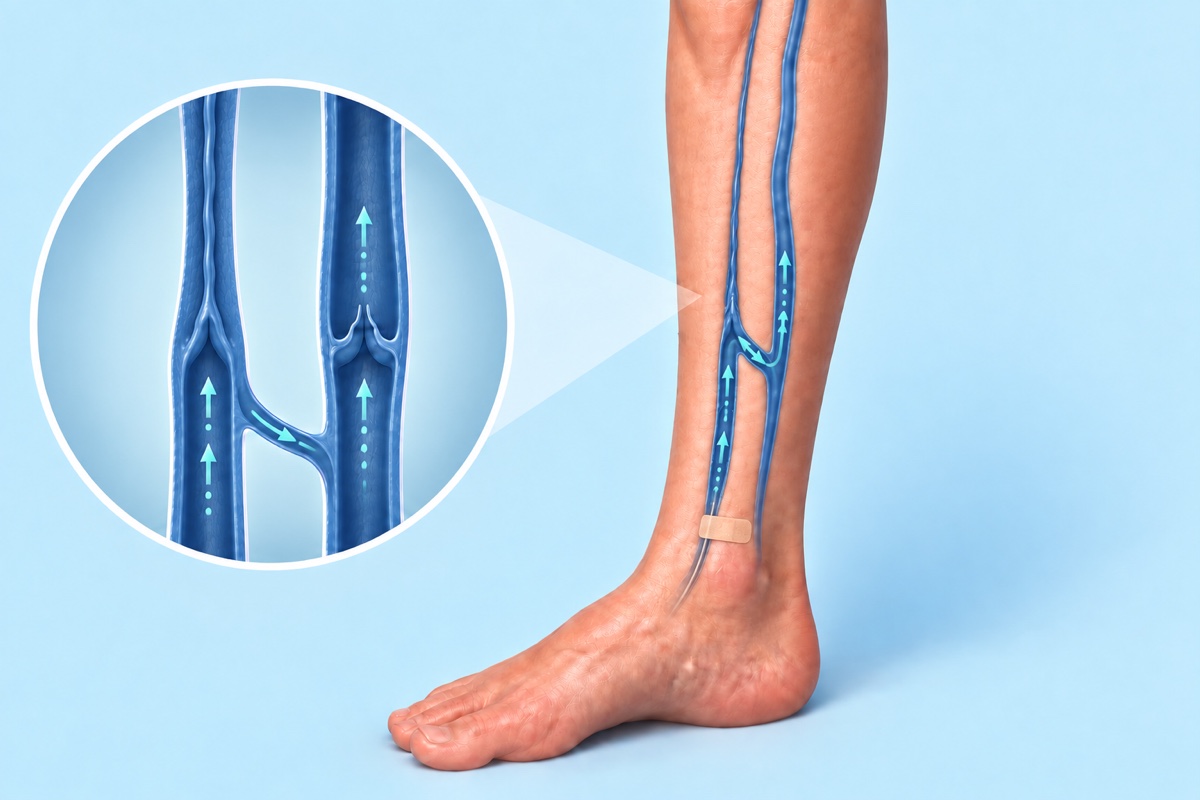
Varicose and spider veins form when tiny valves inside the veins weaken and blood pools instead of flowing back to the heart. Rather than removing the vein with surgery, the specialist seals it closed from the inside. Blood simply reroutes through nearby healthy veins, and the treated vein fades over time.
Depending on the veins, this is done with endovenous ablation, which uses heat, laser, or a medical adhesive through a thin catheter, or with sclerotherapy, a quick injection that closes smaller surface and spider veins. Both are done in the office with local anesthesia and little downtime.
How the treatment works
A quick, image-guided procedure, often finished in under an hour.
- 1
Numb and map
The specialist maps the vein with ultrasound and numbs the skin with local anesthetic.
- 2
Insert the catheter
A very thin catheter or fiber is placed into the faulty vein through a tiny entry point.
- 3
Seal the vein
Gentle heat, laser, or a medical adhesive closes the vein from the inside.
- 4
Blood reroutes
The closed vein fades over time while blood flows through healthy veins nearby.
How treatment can close a faulty vein
Explore four stages of a representative thermal vein treatment, with a nearby healthy vein shown for context.


Why patients choose it
Relief for how your legs feel and how they look.
No vein stripping surgery
A tiny entry point replaces the old surgical removal of veins.
Local anesthesia
You stay awake and comfortable, with no general anesthesia.
Quick office visit
The procedure is often done in under an hour, with no hospital stay.
Walk the same day
Most people walk out and return to normal activities quickly.
Eases symptoms
Relieves the aching, heaviness, and swelling, not just the appearance.
Smoother-looking legs
Treated veins fade over time for a clearer, more comfortable look.
A simpler alternative to old vein surgery
How modern vein ablation compares with traditional vein stripping.
| Modern vein ablation | Traditional vein stripping |
|---|---|
| Tiny entry point, no large incisions | Incisions to remove the vein |
| Local anesthesia in the office | Often general anesthesia |
| Walk out the same day | More bruising and soreness |
| Little downtime | Longer recovery |
Your specialist will confirm the right approach after a quick ultrasound. Many people with varicose or spider veins are good candidates.
Before the procedure: what a specialist checks
Nobody should seal a vein without first proving that vein is the problem. The test that decides it is an ultrasound, and it is worth understanding what it is looking for.
A duplex ultrasound watches blood move through the veins in your leg while you stand. Healthy valves let blood travel up toward the heart and close behind it. When a valve fails, blood falls back down between beats, and the scan can measure how long that backward flow lasts. That measurement, not the appearance of your legs, is what identifies the vein causing your symptoms.
It matters because the visible vein is often not the culprit. Bulging veins at the surface are frequently fed by a larger vein deeper in the thigh or calf that looks perfectly normal from outside. Treating what you can see, while leaving what is feeding it, is how people end up disappointed.
Your specialist will also ask what you have already tried. Most insurers, and most careful doctors, want a documented trial of compression stockings first. That is not a delaying tactic. It establishes whether your symptoms respond to supporting the vein at all, which is useful information either way.
What the results actually look like
Most people notice the aching and heaviness ease within a few weeks, and that symptom relief is the honest headline rather than the appearance of the leg.
Appearance does usually improve, but more slowly and less completely than people expect. The treated vein is sealed and gradually absorbed by the body over months. Surface veins fed by it often shrink, though some remain and need a separate, smaller treatment if they bother you.
The part worth being clear about: sealing a failed vein does not change the tendency that produced it. Family history, how long you spend upright, previous pregnancies and simple age are all still there afterwards. New veins can develop over the following years, and roughly speaking the more risk factors you carry, the more likely that is.
What reduces the chance is unremarkable and continues after treatment. Walking regularly, avoiding long stretches standing still, keeping to a healthy weight, and wearing compression when you are on your feet for a long day. If new symptoms appear years later, that is worth another look rather than assuming the treatment failed.
Risks, stated plainly
This is a low-risk office procedure, and it is still a procedure. You are entitled to hear the risks by name.
The usual ones are mild and temporary. Bruising along the treated vein is normal. So is a pulling or tight feeling down the inside of the thigh or calf, which typically appears about a week afterwards, feels alarming, and settles over a few weeks. Some tenderness and a firm cord under the skin are part of the vein closing, not a complication.
Less commonly, a nerve running alongside the vein can be irritated, leaving a patch of numbness or tingling on the skin. This usually improves, though it can take months and occasionally persists.
The one that matters most is rare: a clot extending from the treated vein into the deep system. That is why you are asked to walk immediately afterwards, why compression is worn, and why a follow-up scan is often arranged. Tell someone promptly about calf pain, swelling or breathlessness rather than waiting.
Risk is higher if you have had a deep vein clot before, if you are less mobile, or if you have a clotting disorder. None of those automatically rule you out, and all of them change the plan.
When a different approach is the better one
Ablation is the right answer for a failing truncal vein. It is not the answer for everything that shows on the surface of a leg.
If your symptoms are mild and manageable with compression, it is reasonable to stay there. Nothing about waiting makes a later procedure harder, and the veins do not become untreatable while you think about it.
If your main concern is fine, flat, threadlike veins rather than raised ropey ones, ablation is not the treatment. Those are spider veins and are usually handled with injections instead. Large, twisting surface veins often need a small removal procedure alongside ablation rather than instead of it.
And if the ultrasound shows the deep veins are the problem rather than the superficial ones, sealing a surface vein can make things worse instead of better, because the leg may be relying on it. That is exactly the situation the scan exists to catch. Our page on chronic venous insufficiency covers the wider picture.
How Help My Legs works
Tell us your symptoms
Answer a few quick questions about your veins and how your legs feel.
We match you locally
We connect you with a qualified vein specialist near your ZIP code.
You get seen
The office reaches out to schedule your visit. No obligation, no pressure.
Common questions
Does it hurt?
Most people feel only a small pinch from the numbing medicine. The procedure is well tolerated, and any soreness afterward is usually mild.
How long is recovery?
Recovery is quick. Most people walk out the same day and return to normal activities within a day or two, often wearing compression stockings for a short time.
Will the veins come back?
Treated veins are closed for good, but new veins can form over time. Follow-up and simple lifestyle steps help keep your legs feeling their best.
Is it just cosmetic?
No. Besides improving how your legs look, closing faulty veins relieves symptoms like aching, heaviness, and swelling. It is often covered when symptoms are present.
Can varicose veins come back after ablation?
The treated vein does not reopen, but new varicose veins can develop over the following years. Ablation seals a failed vein; it does not change the tendency that caused it, and family history, time spent upright and previous pregnancies are all still there afterwards. Walking, compression on long days and a healthy weight reduce the chance. New symptoms years later are worth reassessing rather than assuming the treatment failed.
What are the risks?
Bruising along the vein is normal, as is a tight or pulling feeling in the thigh or calf about a week afterwards that settles over a few weeks. A nerve running beside the vein can be irritated, leaving a patch of numbness that usually improves. The rare but important risk is a clot extending into the deep veins, which is why you walk immediately afterwards and wear compression. Report calf pain, swelling or breathlessness promptly.
Ready for lighter, smoother legs?
Schedule a consultation with a vein specialist near you and see which simple treatment is right for you.
Find a SpecialistLast updated September 2026