
Your knee has been hurting for years. You have had the X-ray, you have heard the words bone on bone, and someone has told you that a knee replacement is what comes next. It is a lot to take in at once, and the question most people ask on the drive home is whether there is anything else.
There usually is. Alternatives to knee replacement run from things you could start this month to procedures most people have never heard of, and for a good number of people they push surgery years down the road or take it off the table altogether. This page walks through six of them. It is also honest about the point where a replacement really is the better answer, because pretending otherwise would not help you.
Why you were offered a knee replacement
Cartilage is the smooth, slippery cap on the ends of the bones inside your knee, and its job is to let the joint glide. In knee osteoarthritis that cartilage gradually wears thin. The gap between the bones narrows, the surfaces begin to catch instead of glide, and the lining of the joint becomes inflamed and sore.
A replacement is offered because it deals with the mechanical half of that problem head on. The worn surfaces are taken out and replaced with metal and plastic ones. It is a genuinely good operation with a long track record, and in the right knee it gives people their life back.
What it is not is the first step, or the only one. The National Institute of Arthritis and Musculoskeletal and Skin Diseases puts it plainly: if other treatments are not helping and the joint damage is extensive, some people may have surgery. Surgery sits at the end of a list, not at the front of it, and the alternatives to knee replacement below are what that list is made of.
Alternatives to knee replacement: six options worth asking about
No single one of these suits everybody, and one or two have probably been mentioned to you already. Taken together, these alternatives to knee replacement are the ground worth covering before you agree to a surgery date.
1. Building up the muscles that support the knee. This is the least exciting item on the list and the one with the best evidence behind it. A strong thigh muscle takes load off the joint every time you stand, walk, or climb a stair. NIAMS lists exercise as a treatment in its own right, noting it can reduce joint pain and stiffness while increasing flexibility, strength, and endurance. The catch is that it has to be the right exercise, done consistently for a couple of months before you judge it. Two weeks is not a trial.
2. Taking load off the joint. Weight is the blunt version of this, and if there is weight to lose, losing it reduces the force going through the knee with every step. But it is not the only lever. A walking stick held in the opposite hand, a properly fitted brace, or insoles can all shift load away from the worn part of the joint. People often resist the stick because of how it looks. It is worth trying anyway, at least to find out how much of the pain is load.
3. Pain medication, including the kind you rub on. Oral anti-inflammatories help many people but carry real risks for the stomach, kidneys, and blood pressure, particularly past 65 and particularly alongside other medications. Topical anti-inflammatory gels are often overlooked and are worth asking about, because the knee sits close enough to the surface for them to reach it with far less exposure to the rest of the body.
4. Injections into the knee. Steroid injections can settle a badly inflamed knee, though the relief tends to be measured in weeks to a few months rather than years. Other injectable options exist and vary in how well they are covered by insurance. Injections are best thought of as a way to buy a window, not as a permanent answer, and if they used to work and have stopped, that is useful information rather than a dead end.
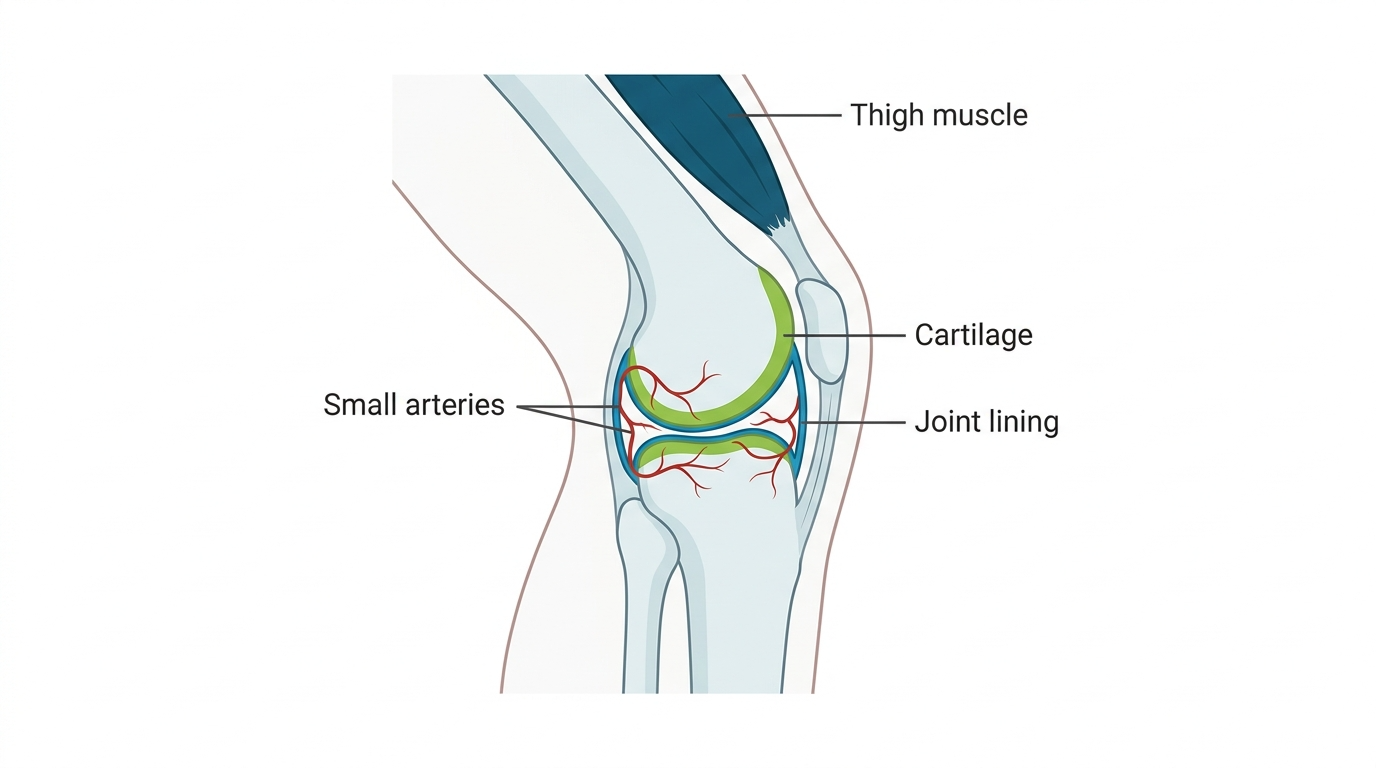
5. Genicular artery embolization. This is the one most people have never heard of. Arthritic knees grow extra small blood vessels that feed the inflamed joint lining, and this procedure reduces the blood flow through them to calm that inflammation. It is done through a small puncture rather than by opening the knee, you are awake, and it is usually a same-day outpatient visit. We explain it properly in our guide to genicular artery embolization, and our page on non-surgical knee pain relief covers what the visit itself involves.
6. A smaller operation than a full replacement. Arthritis does not always affect the whole knee. If it is confined to one side of the joint, a partial replacement resurfaces only that part and leaves the rest of your knee alone. In some younger, more active people an osteotomy, which realigns the bone to move load off the worn side, is another option. Both are surgery, but both are a smaller step than a total replacement.
One thing usually not worth asking for: a keyhole washout of an arthritic knee. Arthroscopy has a real role for other knee problems, but for straightforward arthritis it has not held up well in studies, and most guidelines no longer recommend it.
When knee pain needs urgent attention
Most knee arthritis is not urgent. A few situations are, and they should not wait for a scheduled appointment.
A knee that becomes hot, red, and swollen over hours, especially with a fever or feeling generally unwell, needs same-day assessment. An infected joint is treated as an emergency.
A knee that locks and will not straighten, or one that gives way so completely you cannot put weight through it, should be looked at promptly rather than pushed through.
Sudden swelling in one calf with pain, warmth, or redness is a different problem and needs same-day attention. That combination can point to deep vein thrombosis, a clot in a deep leg vein, which is very treatable but dangerous to ignore. It matters here because reduced activity and recent surgery both raise the risk.
If your symptoms sit outside the joint itself, or you are not certain the knee is even the source, our page on knee pain covers the other causes worth ruling out.
How Help My Legs works
Tell us your symptoms
Answer a few quick questions about your knee, what you have already tried, and what you have been told so far.
We match you locally
We connect you with a qualified specialist near your ZIP code.
You get seen
The office reaches out to schedule your visit. No obligation, no pressure.
When a knee replacement really is the right answer
Alternatives to knee replacement are worth working through properly. They are not worth clinging to once they have stopped earning their place.
The clearest sign is pain at rest. A knee that aches when you are sitting still, and that wakes you at night, has moved past what load management and inflammation control tend to reach. Pain that is only there when you walk a long way leaves you far more room.
The second is how much of your life has quietly shrunk. Not the pain score, the list. The stairs you avoid, the shopping trip you no longer do, the walk you gave up two years ago. When that list is long, waiting has a cost of its own, because muscle and general fitness fall away while you wait and both make the recovery harder later.
The third is a genuine, documented attempt at the other options. A knee that has had months of the right exercise, a proper look at load, medication that was actually tried, and still hurts at rest is a knee that has answered the question.
The honest summary is that delaying surgery is a good idea right up until it is not, and the turning point is different for everybody. That is a judgement to make with someone who has examined your knee and read your imaging, not one to make from a list on a website.
What to ask at your next appointment
Four questions get you further than any amount of reading, and they work whether you are seeing a new specialist or going back to the one who mentioned surgery.
Which of these have I actually tried, and for how long? People are often surprised by how short the real trial was.
Is my arthritis in one part of the knee or all of it? This is the question that decides whether a partial replacement is even possible, and it is answerable from imaging you may already have had.
Am I a candidate for genicular artery embolization? Worth asking directly, because it is newer than the rest of the list and does not always come up on its own.
If I wait a year, does that make surgery harder later? Sometimes the answer is genuinely no. Sometimes it is yes, and you deserve to know which one you are dealing with before you decide to wait.
If you would rather work out where you stand before booking anything, our quick candidate check takes about a minute.
Questions people ask
What are the alternatives to knee replacement?
The main alternatives to knee replacement are strengthening exercise, reducing the load through the joint with weight loss, a brace, insoles or a walking stick, oral and topical pain medication, injections into the knee, genicular artery embolization, and smaller operations such as a partial replacement or an osteotomy. Most people work down that list in roughly that order.
Can you avoid a knee replacement altogether?
Many people do, particularly when the arthritis is caught before it is severe and the muscles around the knee are built up properly. Others delay it by years. Whether you can avoid it entirely depends on how much cartilage is left, which part of the knee is affected, and how well you respond to the earlier options, so it is not something anyone can promise you in advance.
Is genicular artery embolization an alternative to knee replacement?
It is one of the alternatives to knee replacement, and it is aimed squarely at people whose knee pain has not settled with exercise, medication, or injections but who are not ready for surgery. It does not rebuild worn cartilage. What it does is reduce the blood supply feeding the inflamed joint lining, which for many people brings the pain down enough to put surgery off.
How long can you put off a knee replacement?
There is no fixed limit, and plenty of people manage for years. The trade-off is that waiting while your activity drops means losing muscle and general fitness, and both make recovery from surgery harder when you eventually have it. Pain at rest and at night is the usual sign that waiting has stopped paying off.